# When a Stablecoin Pool Repriced BIFI
> A receipt-level event study of how one USDC/mooBIFI pool transmitted an ETH rally across quote currencies, created hundreds of atomic arbitrages, and changed BIFI's marginal mark.
- Canonical URL: https://blog.eggtech.io/posts/when-a-stablecoin-pool-repriced-bifi
- Markdown URL: https://blog.eggtech.io/posts/when-a-stablecoin-pool-repriced-bifi/index.md
- Published: 2026-08-20
- Updated: 2026-08-20
- Author: Kai Aldag
- Reading time: 14 min read
- Tags: Case Studies, Trading, Market Structure, MEV Searching, DeFi, Quantitative Analysis
---
On August 19, ETH rallied roughly 18%. Because most meaningful BIFI liquidity
is quoted in WETH, an unchanged BIFI/WETH exchange rate would have delivered a
similar dollar gain. Instead, BIFI's marginal mark on Optimism rose only 13.2%.
Optimism was the only chain with enough [USDC/mooBIFI
liquidity](https://dexscreener.com/optimism/0x173cdc71e29d5cffa6d090ad99f555a24b8831f9)
to support a viable atomic triangle: USDC → mooBIFI → WETH → USDC. Over the
next 24 hours, 315 transactions bought 176.03 mooBIFI from the USDC pool and
sold the same amount into the WETH pool. The [largest matched
instance](https://optimistic.etherscan.io/tx/0xafe880f77a08cf0ccf336a044aab5c73cc8bd74f32c91d69ea3017552d378f0c)
moved 6.05 mooBIFI through the loop in one transaction.
The USDC pool therefore did more than add liquidity. Its presence
systematically depreciated mooBIFI against ETH: each arbitrage lifted mooBIFI
against USDC while selling it against WETH. This case study reconstructs that
flow and measures how a single stablecoin pool transmitted a dollar anchor
into the wider BIFI market.
- **Event:** ETH rose about 18%, while BIFI's marginal dollar mark on OP rose only about 13.2%, as a cross-rate discrepancy opened between the USDC/mooBIFI and WETH/mooBIFI pools.
- **Identification:** 315 atomic transactions repeatedly bought mooBIFI from the USDC pool and sold it into the WETH pool.
- **Volume:** The matched flow bought and resold 176.03 mooBIFI and paid 9,797.12 USDC into the stablecoin pool.
- **Direct impact:** Those sells contributed a 25.59% multiplicative fall in the WETH/mooBIFI marginal quote along their observed path.
- **Feedback:** 266 WETH-funded buys offset 93.1% of that negative log-price impact.
- **Net mark:** The WETH/mooBIFI marginal quote finished only 3.62% below its start.
- **Counterfactual range:** BIFI's end mark was about $44.43 on OP, $44.86 if anchored to the actual Ethereum BIFI/WETH price, and $46.10 under the stronger assumption that BIFI/WETH never repriced at all.
- **Evidence boundary:** The `$35k-$134k` supply-scaled gaps are non-executable paper marks. The observable classified searcher extraction was only about `$41` gross.
## One Asset, Two Numeraires
mooBIFI is a share of Beefy's BIFI vault. Its BIFI-equivalent value depends on
the vault's price per full share, or PPFS. At the end of this event, one
mooBIFI represented `1.35` BIFI.
On Optimism, that share traded in two pools:
- Velodrome V2 WETH/mooBIFI
- Slipstream USDC/mooBIFI
The pools quote the same exposure against different numeraires. Ignoring fees
and price impact, consistency requires:
```text
(WETH / mooBIFI) x (USDC / WETH) = USDC / mooBIFI
```
Suppose the USDC/mooBIFI quote is slow to move while ETH appreciates. One WETH
now buys more USDC, so the left-hand side rises even if WETH/mooBIFI is
unchanged. Searchers restore the equality by buying mooBIFI with USDC and
selling it for WETH. That trade raises mooBIFI versus USDC while lowering it
versus WETH.
This is why saying that BIFI is “paired with WETH” is not enough to establish
that BIFI will inherit ETH's dollar return. Its dollar price is an identity:
```text
BIFI / USD = (BIFI / WETH) x (WETH / USD)
```
In this event, WETH rose 17.5% in the synchronized OP pool path while the OP
marginal BIFI-equivalent mark fell 3.62% against WETH. It therefore rose only
about 13.2% in dollars.
The canonical route paid 30 basis points in WETH/mooBIFI, 5 basis points in
USDC/WETH, and 100 basis points in USDC/mooBIFI. Their multiplicative fee
factor was `98.65%`, implying a gross cross-rate discrepancy of about 1.37%
before price impact and transaction cost.
## Reconstructing The Loop Onchain
Every log from the two mooBIFI pools between Optimism blocks `155,749,412` and
`155,792,612` was queried, then grouped by transaction hash.
A transaction entered the target set only if it contained:
1. USDC entering the USDC/mooBIFI pool;
2. mooBIFI leaving that pool;
3. the same mooBIFI amount entering the WETH/mooBIFI pool; and
4. WETH leaving the WETH pool.
This deliberately identifies the economic cycle before assuming a particular
router. Of the 315 matched transactions, 171 used the canonical three pools
exactly once. The remainder used alternate WETH/USDC pools, Uniswap v4 with a
native-ETH leg, an RFQ-style connector, or balance-sheet conversion.
Calling every transaction a literal “three-AMM arbitrage” would therefore be
wrong. They were all cyclic cross-rate trades, but only 171 had the simplest
three-pool implementation.
The matched set contained 19 executing contracts. The largest accounted for
32.29% of mooBIFI volume; the largest three accounted for 60.72%. This was a
competitive market response, not one wallet producing a statistical accident.
## The Direct Push And The Reflexive Pull
For the WETH/mooBIFI V2 pool, every `Sync` event reveals the exact reserves
immediately after a state change. Pairing those states with each `Swap` yields
the before-and-after marginal quote.
Log price changes make the path attribution additive. If a swap changes the
marginal price from `p0` to `p1`, its contribution is:
```text
log(p1 / p0)
```
Summing those contributions by transaction class separates the stablecoin
cycle from the flow that followed it.
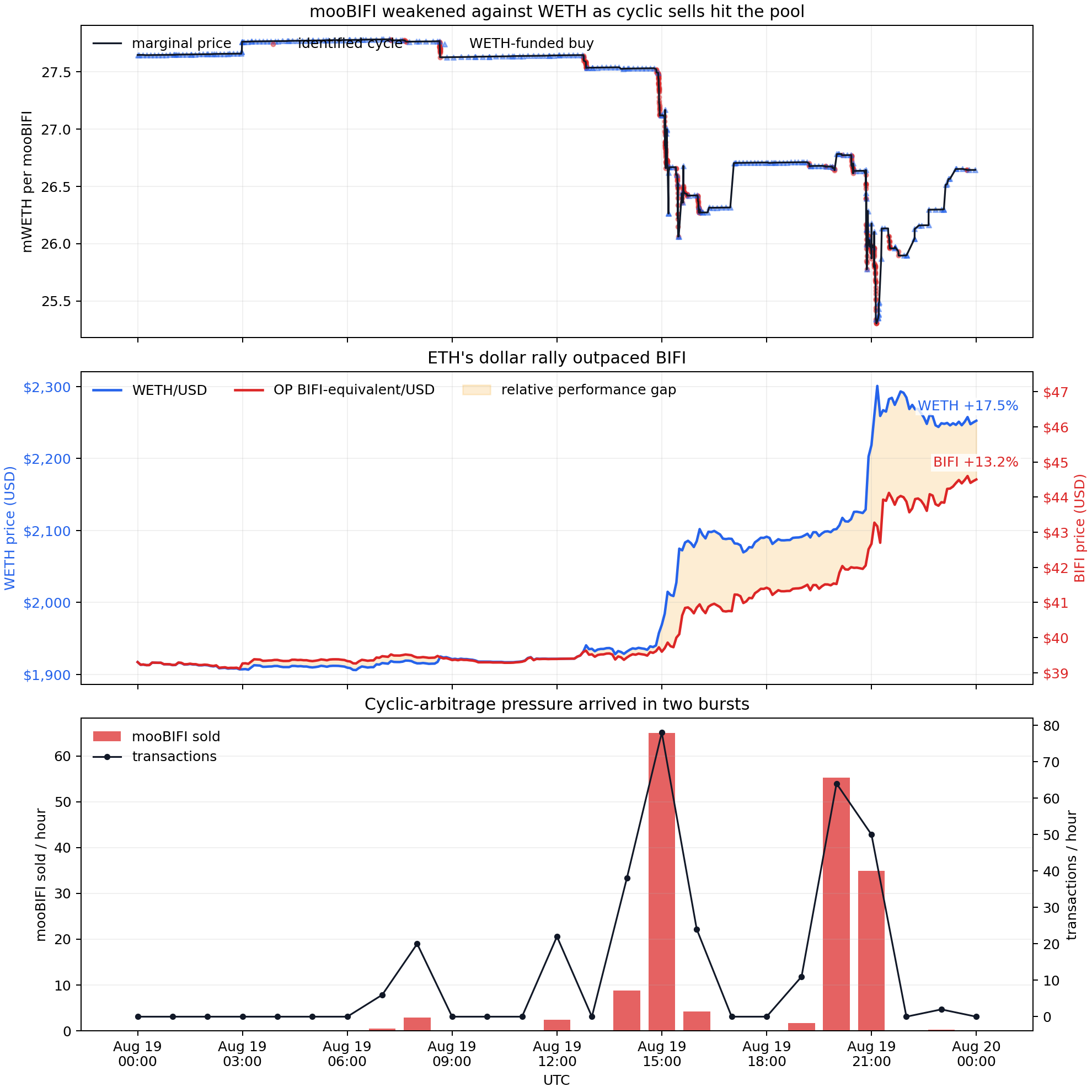
The dollar view makes the divergence easier to see. WETH/USD was reconstructed
from the canonical OP WETH/USDC pool. The OP WETH/mooBIFI marginal quote was
then converted into a BIFI-equivalent dollar mark using fixed end-of-window
PPFS, with both dollar prices plotted over the same event timeline.
WETH/USD finished 17.5% higher. The OP BIFI-equivalent mark finished only 13.2%
higher, a 4.26 percentage-point shortfall. The first material separation opens
alongside the large 15:00 UTC burst of cyclic volume, then widens again as the
second burst arrives around 20:00 UTC.
The 315 cyclic transactions contained 320 target WETH/mooBIFI swaps and sold
176.03 mooBIFI into the pool. Along their observed path, those swaps
contributed `-2,956.20` log basis points, a 25.59% multiplicative decline.
But that was not the end state. As OP became cheap, other traders bought it.
| Flow class | Swaps | Log impact | Multiplicative move |
|---|---:|---:|---:|
| Cyclic flow: mooBIFI to WETH | 320 | -2,956.20 bp | -25.59% |
| WETH-funded buys | 266 | +2,753.70 bp | +31.70% |
| Other mooBIFI sales | 75 | -166.63 bp | -1.65% |
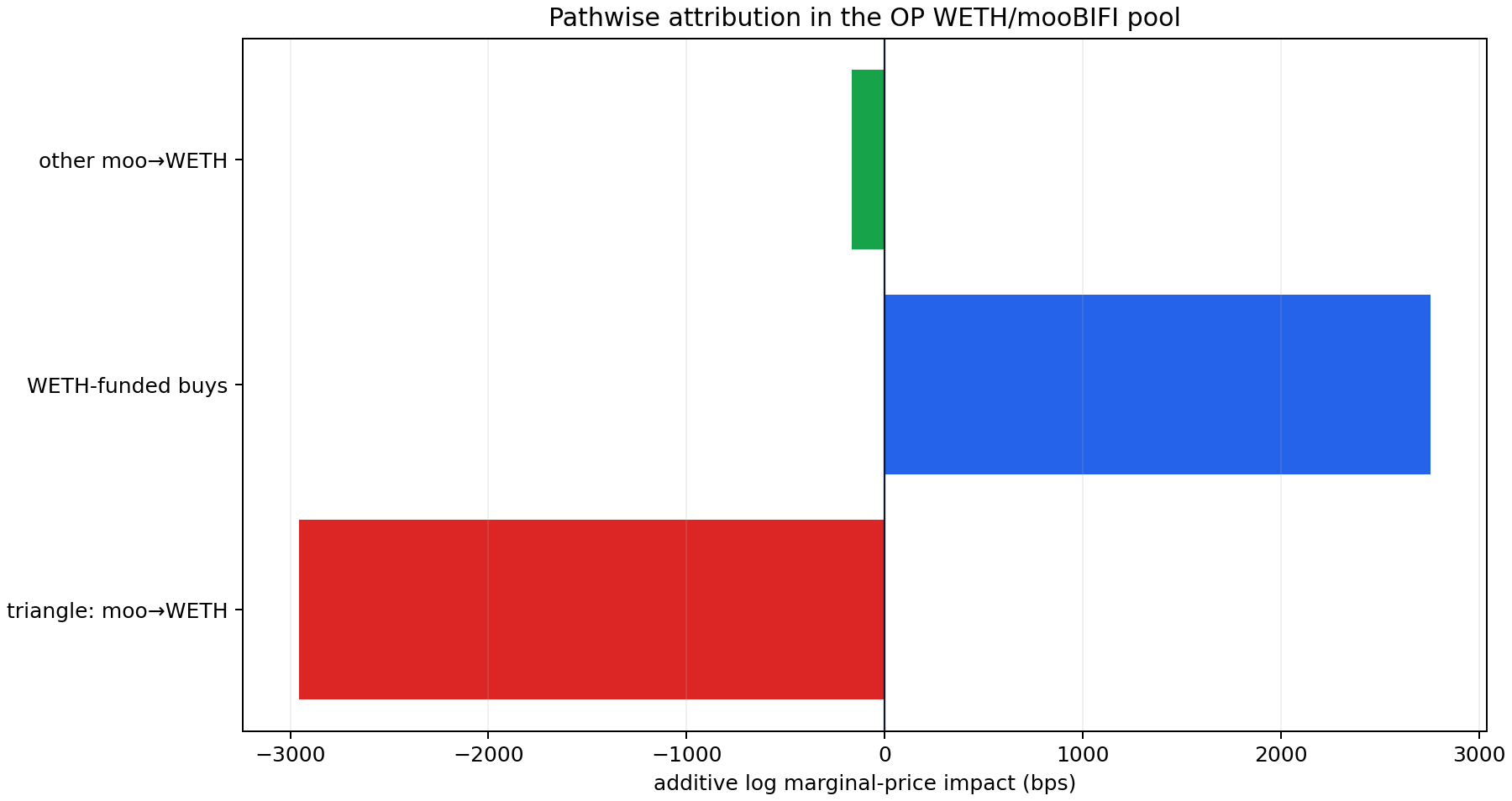
The 266 WETH-funded buys offset 93.1% of the triangle's negative log impact.
Recipient-matched hedges show that part of this response came from cross-chain
arbitrageurs buying cheap mooBIFI on OP and selling BIFI-equivalent exposure on
Base or Ethereum.
That response makes the event reflexive:
```text
USDC anchor opens cyclic sell
-> mooBIFI becomes cheap versus WETH elsewhere
-> cross-chain arbitrageurs buy OP and sell Base/Ethereum
-> OP partially recovers while pressure propagates outward
```
The OP marginal quote began at `27.65 mWETH` per mooBIFI and finished at
`26.64 mWETH`, down 3.62% rather than 25.59%.
## What Did The Arbitrageurs Actually Extract?
Complete connector economics were reconstructable for 295 of the 315 matched
transactions. The remaining 20 used inventory or connector behavior for which
public swap deltas do not expose a complete profit. Their profit is therefore
left unavailable rather than treated as zero.
Across the classified subset:
- gross cyclic profit was `18.38 mWETH`;
- observed OP receipt costs were `3.81 mWETH`;
- net profit after those receipt costs was `14.57 mWETH`; and
- 294 of 295 transactions remained positive after receipt cost.
Using the block-pinned ETH/USD reference of `$2,248.40`, that is about
`$41.33` gross and `$32.75` net.
The gross amount is value extracted across the network of AMMs and RFQ
counterparties after pool fees. It is not automatically “loss from the
USDC/mooBIFI LPs.” Allocating loss to a particular pool requires marking every
pool's inventory against a common fair price after the trade. Concentrated
liquidity positions add another layer because different ranges own different
amounts of the event.
This is where loss-versus-rebalancing, or LVR, becomes the right framework. LVR
compares the LP with a continuously rebalanced benchmark at the external price.
The searcher's gross profit is observable transfer. Full position-level LVR is
a separate calculation.
## So How Much Did BIFI Holders Lose?
There are three different quantities hiding inside that question.
The first is **realized counterparty extraction**. For the classified routes,
that was about `$41.33` gross. This is an actual flow quantity.
The second is a **marginal price difference**. At the end of the window, the
production reference frame had:
- ETH/USD at `$2,248.40`;
- PPFS at `1.35`; and
- observed OP BIFI-equivalent value at about `$44.43` per BIFI.
The third is a **supply-scaled paper mark**: marginal price difference times
80,000 BIFI. That number is tempting and usually misleading because 80,000
BIFI could not execute against a thin marginal quote.
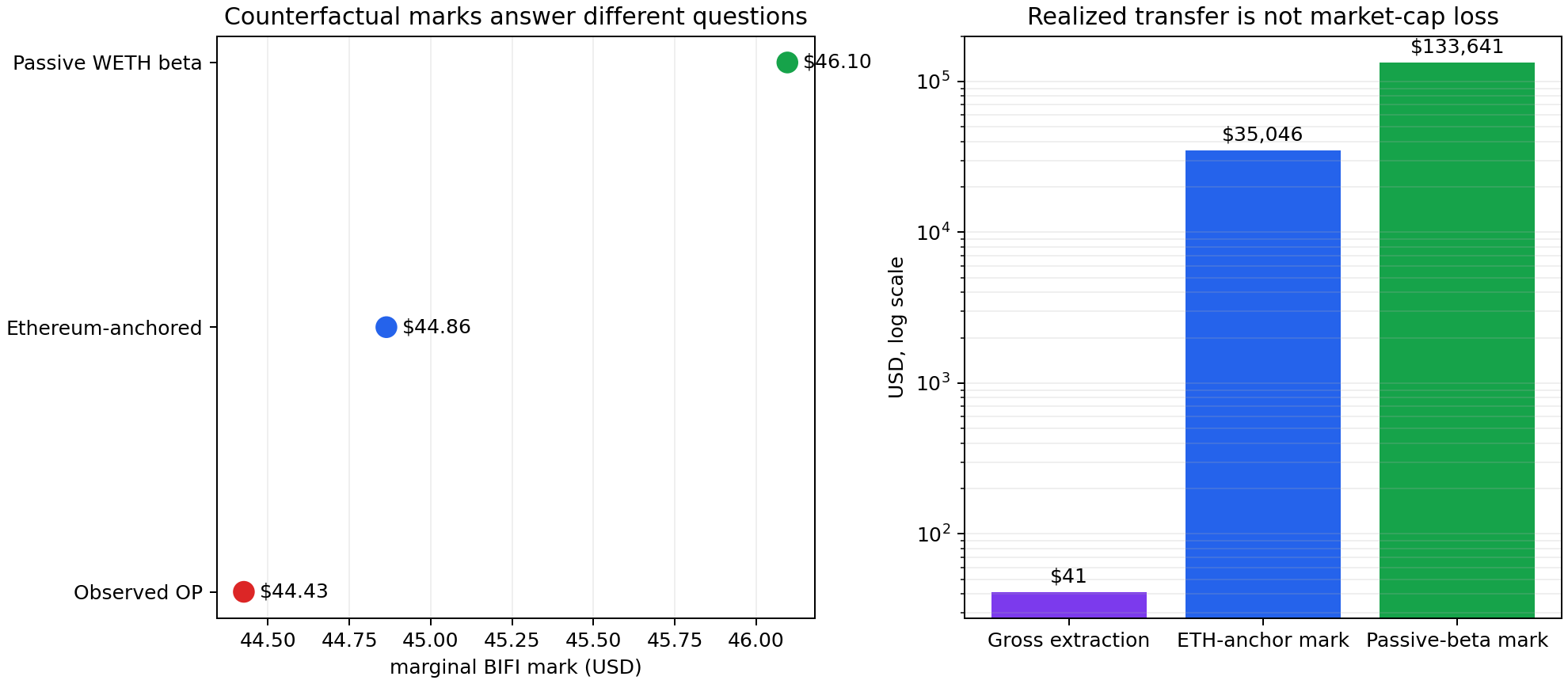
Two counterfactual benchmarks bound the result.
### Benchmark 1: OP converges to actual Ethereum
Ethereum is the primary BIFI/WETH price-discovery venue. Its pool had 90 swaps
during this event and fell 3.31% versus WETH. BIFI/WETH was therefore not
passive even away from the OP stablecoin pool.
If OP had ended exactly at Ethereum's observed BIFI/WETH marginal price, the
OP-equivalent BIFI mark would have been about `$44.86`: `$0.44`, or 0.99%,
above observed OP. Multiplying that marginal difference by 80,000 produces a
paper mark gap of roughly `$35,046`.
This is the conservative network benchmark, but it may understate the
no-USDC-pool effect. Cross-chain arbitrageurs bought the OP weakness and sold
on Base or Ethereum, so some of the stablecoin pressure may already have been
exported into the Ethereum control price.
### Benchmark 2: BIFI/WETH never reprices
The stronger hypothetical holds the opening WETH/mooBIFI ratio constant while
ETH rises. Under that passive-WETH-beta assumption, BIFI ends near `$46.10`, or
`$1.67` above observed OP. The 80,000-token paper mark gap is approximately
`$133,641`.
This answers the original “what if there were only quiet WETH pools?” question,
but the chain data rejects its premise as a description of the real market.
Ethereum BIFI/WETH did trade and did fall.
The defensible conclusion is therefore a range, not a point estimate. The
stablecoin pool created the observed cyclic sell pressure. Its direct pathwise
impact was large. The final holder mark was buffered by cross-chain buyers and
confounded by independent—or partly endogenous—BIFI/WETH selling elsewhere.
***The `$41` gross extraction is realized flow. The `$35k-$134k` figures are
non-executable paper-mark sensitivities. Calling either paper mark “value
holders lost” without that distinction would be a market-cap fallacy.***
The execution curve shows why. The observed pool was moved along the same
constant-product liquidity curve to each counterfactual marginal price, then
exact BIFI-equivalent sizes were sold back into WETH with the pool's
30-basis-point fee.
| BIFI sold | Observed average $/BIFI | Ethereum-anchor average | Passive-beta average |
|---:|---:|---:|---:|
| 1 | $44.26 | $44.70 | $45.93 |
| 10 | $44.02 | $44.45 | $45.67 |
| 100 | $41.69 | $42.09 | $43.21 |
| 1,000 | $27.25 | $27.47 | $28.08 |
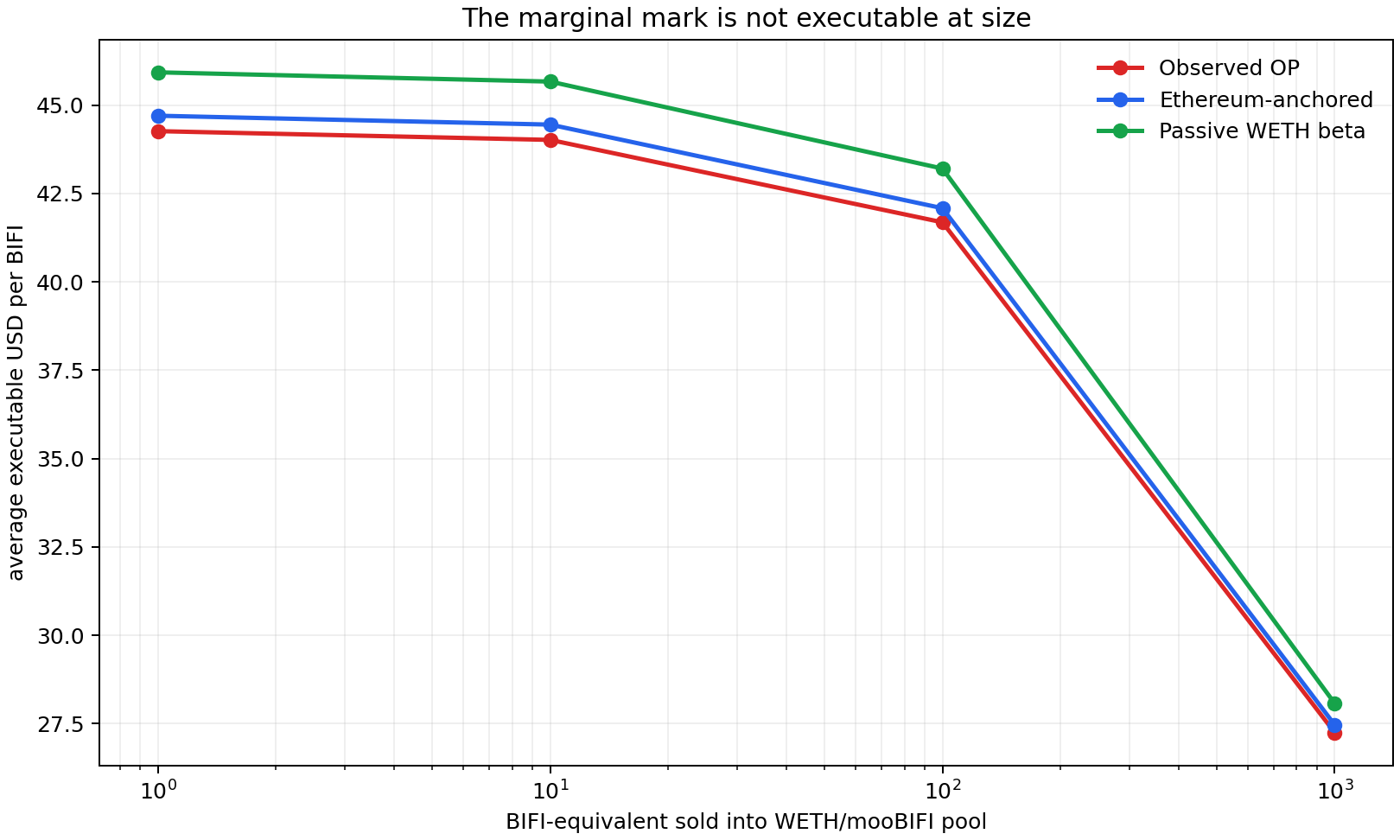
At 1,000 BIFI, the Ethereum-anchor marginal mark implies `$438` of incremental
value. The executable difference is only `$217`. Even that is a controlled
single-pool sensitivity: it holds liquidity constant and does not assume other
venues would stand still during a sale.
This mechanism is not intrinsically bearish for BIFI. If WETH falls rapidly
while USDC/mooBIFI remains sticky, the profitable cycle reverses: searchers buy
mooBIFI from the WETH pool and sell it into the USDC pool. That flow lifts
mooBIFI against WETH and cushions its dollar decline. The same stablecoin
anchor that capped BIFI's upside in this event can support its WETH-relative
price during a sell-off.
## Following the Hedges Across Chains
All 266 WETH-funded mooBIFI buys on OP were screened for matching sales into the
Base mooBIFI/WETH and Ethereum BIFI/WETH pools.
The join is conservative. A hedge must have the **same swap recipient**, occur
in the same order, and sell a BIFI-equivalent amount within 2% of the OP buy.
Timing alone cannot produce a match. Ethereum BIFI is normalized with the
end-of-window PPFS, which introduces a small amount of drift for trades earlier
in the day.
| Matched flow | OP buys | mooBIFI bought on OP | Base hedges | Ethereum hedges |
|---|---:|---:|---:|---:|
| **Cross-chain matches** | **26** | **119.36** | **17** | **9** |
For example, this other searcher [bought 6.71 mooBIFI on
OP](https://optimistic.etherscan.io/tx/0x0fbf8263e111901116ec7b573abc63ede2be8ffde02a13dcb8e02a093b2aeba3),
then [sold the normalized BIFI-equivalent on
Ethereum](https://etherscan.io/tx/0xdd29892cd0974257b99a37ed8e3fc9dac255036013a1f52b9e43d1ec9f2950c7)
42 seconds later. The fixed end-of-window PPFS leaves a 0.53% size difference.
Those 26 proven cross-chain buys account for **72.9% of all WETH-funded buy
volume** and contributed **2,008.63 positive log basis points**—enough to
offset 67.9% of the target cycle's direct negative log impact. The remaining
240 small buys moved 44.37 mooBIFI and cannot be assigned to a cross-chain
hedge from these two pools with the same confidence.
### How Much of That Buying Was a Response to the Stablecoin Cycle?
The recipient-and-size join proves cross-chain hedge flow. It does not, by
itself, prove why each trader acted. Event ordering supplies a second layer of
evidence:
- 99.83 of the 119.36 matched mooBIFI—83.6%—was bought within five minutes
after an identified USDC cycle;
- that five-minute subset alone was 61.0% of all WETH-funded buy volume; and
- 68.15 matched mooBIFI was bought immediately after a target cycle in the
WETH/mooBIFI pool's event order.
This is the endogenous feedback loop visible in the data: the stablecoin cycle
sold mooBIFI into WETH, the cheaper OP quote attracted cross-chain buyers, and
those buyers exported the basis by selling on Base or Ethereum. The evidence
does not support attributing all 119.36 mooBIFI to the USDC pool—some arrived
long after the most recent cycle—but 99.83 mooBIFI has both an identified
cross-chain hedge and tight event-time proximity.
The 42-second example is also a reminder that this is non-atomic cross-chain
arbitrage. Exact recipient and size evidence can establish a strong link, but
the delay between legs remains inventory risk rather than atomic execution.
## What the Pools Earned
The swaps also reveal the gross fee budget, although not yet each LP position's
return.
The target cycles paid 9,797.12 USDC into the 1% USDC/mooBIFI pool, implying
**$97.97 of gross swap fees**. They also sold 176.03 mooBIFI into the 30 bp
WETH/mooBIFI pool, implying **0.53 mooBIFI of gross fees**, worth about
**$31.64** at the reference mark. Combined, the two mooBIFI pools charged about
**$129.61** on the target legs before any protocol split or position-level
allocation.
Across all swaps in the day—not only the target cycles—the WETH/mooBIFI pool's
gross fee inputs were 12.98 mWETH and 0.56 mooBIFI. The USDC/mooBIFI pool's
were 167.63 USDC and 0.04 mooBIFI.
This still does not answer position-level LVR. Determining whether a particular
LP's fees compensated for adverse selection requires every position's active
liquidity and tick range, fee-growth checkpoints, ownership changes, and the
protocol-fee share at each swap. Likewise, a true all-venue exact-size curve
requires synchronized tick liquidity—not just the marginal swap prices—on OP,
Base, and Ethereum. Those are now the two genuinely unresolved measurements,
rather than a generic list of future work.
The event already demonstrates something more general. A small pool quoted in
a different numeraire can become a transmission channel during a macro move.
Its TVL does not bound its influence to its own venue. Arbitrage can propagate
its price through another pool, attract cross-chain hedging, and export the
pressure into the market that was supposed to be the reference.
Liquidity fragmentation is not just several prices waiting to converge. It is
the mechanism that decides which price gets carried where—and who gets paid to
carry it.
Reproducibility and limitations
The core analysis script is `scripts/bifi-triangle-event-study.py`. The
cross-chain join and fee study is
`scripts/bifi-cross-chain-response-study.py`. Together they emit the JSON
summaries, transaction CSVs, WETH/mooBIFI swap CSV, synchronized USD-price-path
CSV, cross-chain match CSV, and figures in this post. All executable amounts
and reserve changes are reconstructed as integers; floating point is used only
for display and plotting.
Receipts prove transaction success, public logs, gas used, effective gas price,
and OP L1-data fee. They do not reveal a private builder or order-flow payment
that is absent from the receipt. Profit for 20 inventory-style routes remains
unavailable. The production PPFS and ETH/USD frame is block-pinned evidence,
but one reference frame does not prove simultaneous executable depth at every
venue.
The cross-chain join uses exact swap-recipient identity plus ordered,
size-compatible flow. Its 2% tolerance accommodates time-varying PPFS when an
Ethereum BIFI sale is normalized with the fixed end-of-window PPFS. Timing is
reported only after identity and size establish a match. It supports a strong
response classification, not a structural proof of each searcher's private
decision rule. Gross pool fees are fees charged to swap inputs before protocol
splits and position-level allocation; they are not net LP income.
Pathwise impact is exact for the observed before-and-after marginal moves. It
is not itself a behavioral counterfactual: removing a trade changes the price
seen by every later trader. The replay variants hold later inputs fixed and are
useful sensitivity checks, not equilibrium estimates.